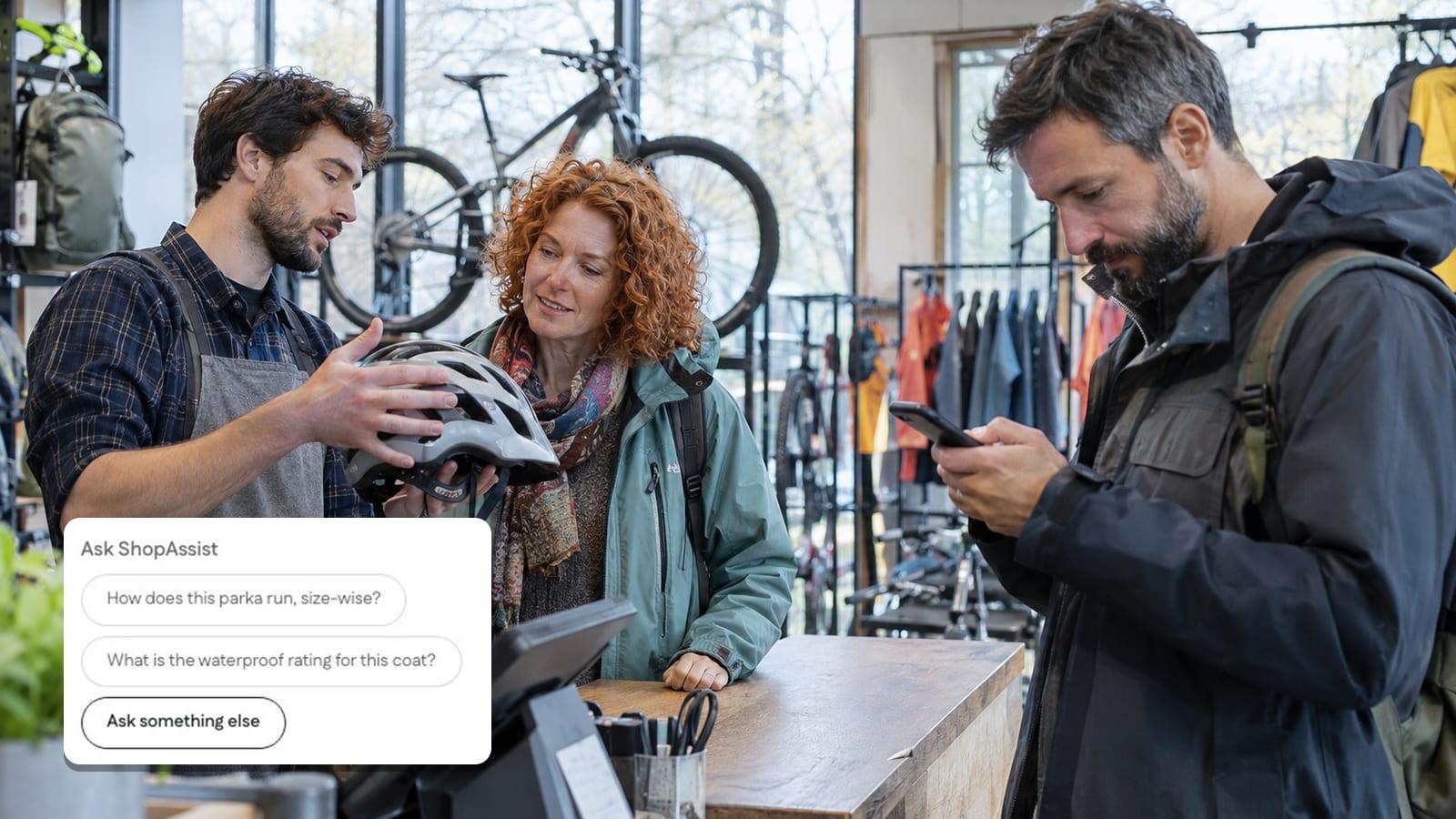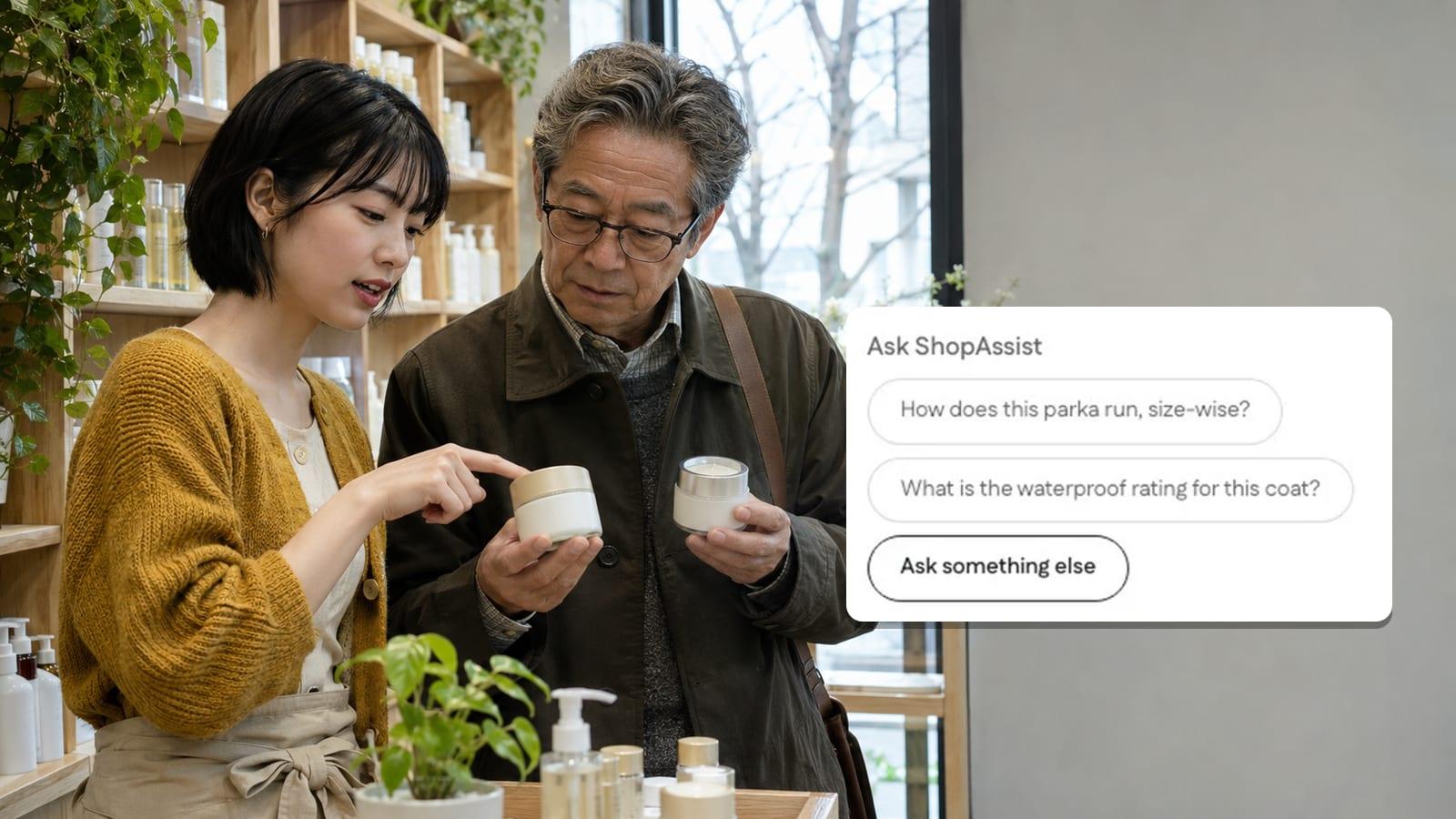
Most eCommerce stores are built as catalogues.
Shoppers browse categories, adjust filters, open product pages, compare tabs, read FAQs and try to reach a decision on their own.
That works when the shopper knows the product name and the catalogue is simple. It works less well when they arrive with a need:
- •"Which serum is suitable for sensitive skin?"
- •"What is the difference between these two jackets?"
- •"I need a gift for someone who enjoys cooking."
- •"Which model is compatible with my current setup?"
An AI shopping assistant is designed for these questions. It gives shoppers a conversational way to find, compare and understand products without navigating the entire store alone.
What does an AI shopping assistant do?
An AI shopping assistant is a shopper-facing tool that uses the store's catalogue and knowledge sources to help visitors make buying decisions.
It can support tasks such as:
- •finding products from a natural-language request
- •asking clarifying questions
- •recommending relevant options
- •comparing similar products
- •explaining ingredients, materials, sizing, compatibility or usage
- •answering product, policy, shipping and returns questions, based on the information the store provides
- •linking shoppers to a product page or a cart action, where configured
The easiest comparison is a capable in-store salesperson. A good salesperson does not simply point at an aisle. They understand the need, narrow the options, explain the trade-offs and help the customer decide.
An AI shopping assistant brings that kind of guidance to an online store.
How is it different from a support chatbot?
The difference is mainly the job each tool is designed to do. We cover it in more depth in the difference between AI chatbots and AI assistants.
A traditional support chatbot often focuses on predictable service tasks: routing enquiries, sharing help-centre links or collecting details for a support ticket.
An AI shopping assistant focuses on the buying decision.
| Shopper need | Typical support chatbot | AI shopping assistant |
|---|---|---|
| Find a product for a use case | May return a category or search link | Can narrow the catalogue around the stated need |
| Compare two products | May link to both product pages | Can explain relevant differences in one conversation |
| Ask a detailed purchase question | Often depends on predefined answers | Can use connected product and knowledge sources |
| Take the next step | Usually routes elsewhere | Can show product cards, links, favourites or cart actions where supported |
These categories can overlap. Modern support platforms may use AI, and a shopping assistant may also answer configured service questions. The important distinction is whether the experience is designed mainly to manage requests or to help someone choose and buy.
Why search and filters are not always enough
Search works well when shoppers know the language used in your catalogue.
But shoppers often describe an outcome rather than a product:
- •"waterproof jacket under €200"
- •"lightweight yoga mat for travelling"
- •"moisturiser for dry, sensitive skin"
- •"headphones for calls in a noisy office"
Filters also depend on the merchant predicting which attributes matter and on the shopper knowing how to combine them. When neither works, shoppers often give up on the search altogether, a pattern we look at in why shoppers abandon eCommerce search.
Conversational product discovery gives the shopper another route. They can explain what they need in their own words. The assistant can then clarify the request, surface relevant options and explain why each one may fit.
This does not make search or filters obsolete. It gives shoppers useful guidance when traditional navigation becomes too rigid or demanding.
Where does an AI shopping assistant create value?
The strongest use cases usually involve friction around choosing a product.
Product discovery
A shopper knows the problem they want to solve but not the product name. The assistant translates that need into a relevant shortlist.
Product comparison
A shopper is choosing between similar items. The assistant highlights meaningful differences without requiring several open tabs.
Purchase questions
A shopper needs clarity on fit, ingredients, compatibility, delivery, care or intended use before they can commit.
International guidance
A merchant sells across markets and wants to offer useful pre-sales guidance outside local support hours and in the languages the store supports.
Customer-intent insight
Conversation data can show what shoppers look for, what they fail to find and which questions repeatedly hold up decisions.
Which stores should consider one?
An AI shopping assistant is worth testing when:
- •the store already attracts meaningful traffic but conversion has plateaued
- •the catalogue contains many products, variants or technical attributes
- •shoppers frequently ask pre-sales questions
- •products need explanation or comparison
- •the team serves several markets or languages
- •support repeatedly answers questions that affect purchase confidence
- •the merchant wants better insight into customer intent
It may be less useful for very small catalogues, low-consideration purchases or stores with incomplete product data. The quality of the guidance depends on the quality and availability of the information behind it.
Where ShopAssist fits
ShopAssist is an AI shopping assistant for eCommerce stores on Shopify, WooCommerce, BigCommerce and Magento. It connects to the store's catalogue and configured knowledge sources so shoppers can ask questions, get recommendations, compare products and move towards a product page or cart action where supported.
It is designed for the part of the journey between landing and checkout: the point where shoppers are interested but still uncertain.
Skincare brand Elinor, for example, uses ShopAssist as an online beauty advisor that answers skin questions and recommends products. In its first three months, orders assisted by ShopAssist made up more than 12% of the webshop's revenue. Read the Elinor customer story.
The goal is not to add another chat window. It is to make the store more helpful at the moment a shopper needs to decide. You can see how plans are structured on our pricing page.
The practical takeaway
Checkout optimisation matters, but shoppers first have to decide what to buy.
An AI shopping assistant gives them a direct way to describe a need, understand the options and get answers while purchase intent is active.
For merchants, that is a practical opportunity: guide more of the visitors who are already in the store, instead of leaving each shopper to work out the buying decision alone.
If you would like to see how this would work with your catalogue, book a demo.
Ready to turn visitors into buyers?
See how ShopAssist can boost your conversion rate and revenue.